 Posted by
 ‘In many cities around the world, cemeteries have become visitor attractions. This is usually because well-known artists, writers or politicians are buried there. A famous example is the grave of Jim Morrison at the Père-Lachaise Cemetery in Paris, which is visited by fans every day.
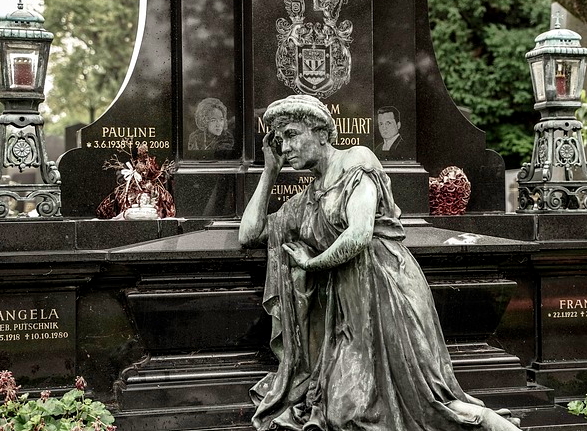
Vienna, however, stands out even by international standards. Nowhere else are so many influential cultural figures buried in one place as at the Vienna Central Cemetery in the Simmering district. With its enormous size and long history, it is not only a burial ground but also an important part of the city’s cultural heritage.
The cemetery is especially famous for the graves of great composers. Visitors can see the final resting places of Beethoven, Schubert, Brahms and Johann Strauss. Mozart is also commemorated here with an honorary grave, although his actual burial site is at St. Marx Cemetery, elsewhere in Vienna. In addition to classical music legends, more modern Austrian icons such as Udo Jürgens, Hans Moser and Falco are buried here as well.
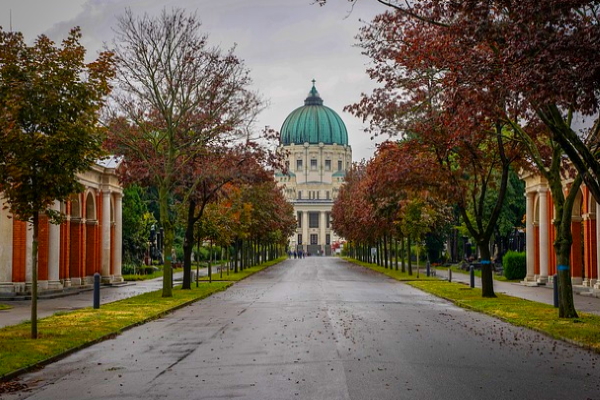
Beyond the world-famous graves, the Vienna Central Cemetery has other highlights worth seeing. The large cemetery church, built in elegant Art Nouveau style, is an impressive landmark and one of the most beautiful buildings on the grounds. Close to Gate 2, the Funeral Museum Vienna offers a fascinating insight into Vienna’s funeral traditions, including elaborate ceremonies for members of the nobility and wealthy citizens in the 18th and 19th centuries.
Size of the Vienna Central Cemetery
The sheer size of the Vienna Central Cemetery is one of its most striking features. Since it opened in 1874, around 3 million people have been buried here. This number is higher than Vienna’s current population, which shows how important the cemetery has been for the city over generations.
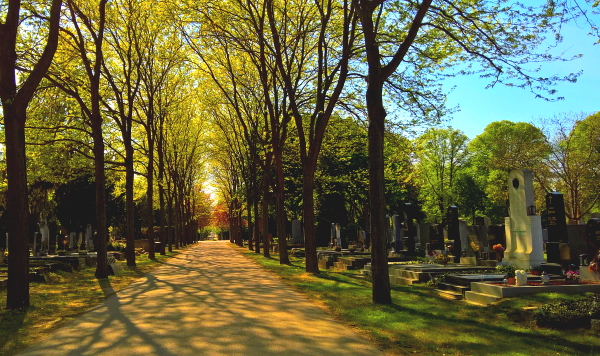
Today, the cemetery contains approximately 330,000 graves. For many decades, it was considered the largest cemetery in Europe, and it was expanded several times to keep up with Vienna’s growth. Even now, its dimensions are impressive: the total area covers about 2.5 million square meters.
Because of its size, visitors should plan their visit carefully. The cemetery has entrances on several sides, and choosing the right one can save a lot of walking time. If you enter from the wrong side, reaching a specific grave can easily take 30 minutes or more on foot. Many of the main entrances are conveniently accessible by subway and tram, which makes orientation and planning much easier.
How to Get There and Which Entrance to Use
The Vienna Central Cemetery is enormous. From one end to the other, it stretches for roughly 3 to 4 kilometers, so choosing the right entrance makes a big difference. Most visitors come to see the graves of famous musicians, and these are concentrated in one main area of the cemetery.
Best Entrance for Famous Graves
If you want to visit the graves of Mozart, Beethoven, Schubert, Johann Strauss (father and son), Brahms and Udo Jürgens, you should enter through Gate 2 (2. Tor). This is the most practical entrance for first-time visitors. Tram lines 11 and 71 stop directly here at “Zentralfriedhof 2. Tor”.
After entering the cemetery, you will immediately notice a clear layout:
-
on the right, you will find the Funeral Museum
-
on the left, there is a small sausage stand, a typical Viennese detail
Walking Route Inside the Cemetery
From Gate 2, walk straight ahead along the wide main path toward the large, clearly visible cemetery church. About 100 meters before the church, the honorary graves of the great classical composers appear on the left-hand side. The graves of Beethoven, Schubert, Brahms and the Strauss family are located close together, along with the memorial for Mozart.
It is also worth taking a short look at the impressive church itself and the honorary graves of the Austrian Federal Presidents located nearby. The grave of Udo Jürgens, who died in 2014, is also situated on the left side, just in front of the church.
Other Famous Graves
Not all well-known graves are in the same area. The grave of Falco, famous for “Rock Me Amadeus”, is located about one kilometer away from the central musicians’ section. The grave of actor Curt Jürgens, who died in 1982, also attracts many visitors and is relatively close to the classical composers’ graves.
Public Transport to Vienna Central Cemetery
Getting there by public transport is easy. Take the U3 subway (orange line) to its final stop Simmering. From there, change to tram 11 or 71 and ride for four stops to “Zentralfriedhof 2. Tor”. From this entrance, the most important sights are within easy walking distance.
Important graves Central Cemetery Vienna
The Central Cemetery is divided into many parts, which are numbered. Almost all important musicians are in section 32a
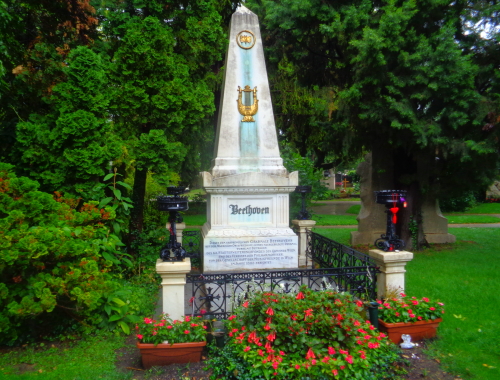
Grave of Beethoven
Ludwig van Beethoven was not originally buried at the Vienna Central Cemetery. Like his close friend Franz Schubert, whose grave lies nearby today, Beethoven was first laid to rest at the former Währing Cemetery in Vienna. Only later were both composers reburied at the Central Cemetery, where Vienna created a special place for its greatest musicians.
Today, Beethoven’s grave is one of the most famous and most visited sites in the entire cemetery. For many visitors, it is the main reason to come to the Vienna Central Cemetery at all. The grave is located in the section with the honorary graves of classical composers, close to Schubert, Brahms and Johann Strauss, making this area one of the cultural highlights of the cemetery.
If you visit the Central Cemetery for the first time, the grave of Beethoven is almost impossible to miss – and it is usually surrounded by visitors paying their respects to one of the most influential composers in music history.
Strauss grave
Just a few meters away from Beethoven’s grave lie the burial sites of the two most famous members of the Strauss family: Johann Strauss I and his son Johann Strauss II. Father and son shaped Vienna’s musical reputation like hardly anyone else.
Johann Strauss I became world-famous with works such as the Radetzky March, while Johann Strauss II is best known as the “King of the Waltz” and the composer of the Blue Danube. Their graves are among the most visited in the Vienna Central Cemetery and are an essential stop for music lovers.
Close by, visitors will also find the grave of Johannes Brahms and other important composers. All these honorary graves are located in Section 32A, making this area one of the most concentrated and impressive cultural highlights of the cemetery.
Tomb of Mozart
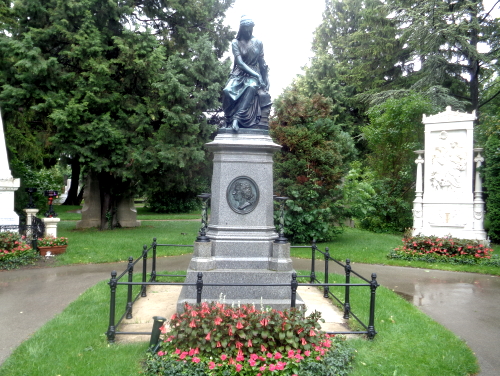
Wolfgang Amadeus Mozart is Austria’s most famous composer, and his name is closely connected with Vienna. At the Vienna Central Cemetery, visitors will find a tomb dedicated to Mozart, but this site is not his actual burial place.
Mozart was originally buried at the St. Marx Cemetery, also located in Vienna. The grave at the Central Cemetery therefore serves as a memorial and honorary monument, created to place Mozart symbolically among Vienna’s greatest composers.
The Mozart memorial is located right next to the graves of Beethoven, Schubert, Brahms and the Strauss family. This makes it easy for visitors to see all the most important composers in one short walk and highlights Mozart’s lasting importance in Vienna’s musical history.
Udo Jürgens Grave
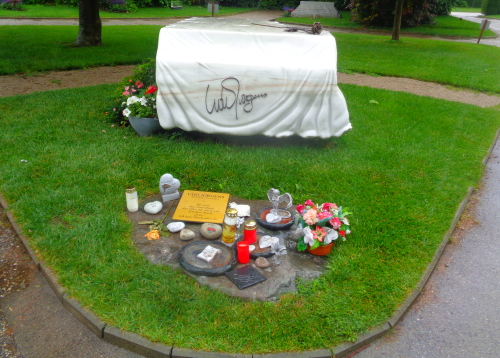
Udo Jürgens is one of the most popular and influential entertainers of the German-speaking world. His funeral in 2014 was one of the largest and most emotional ceremonies held at the Vienna Central Cemetery in recent decades. Only the burial of Falco attracted a comparable level of public attention.
Udo Jürgens is best known for songs such as Greek Wine and many other classics that shaped popular music for generations. His grave is located in Section 33G of the cemetery.
Visitors usually reach the grave by entering through Gate 2 and walking toward the large cemetery church. From there, the grave lies to the left of the main path, slightly closer to the church than the composers’ honorary graves, but clearly separated from them. Compared to many traditional monuments, the grave of Udo Jürgens stands out with its modern and elegant design, reflecting his long career as a contemporary artist.
Falco Grave
Falco is buried in a different part of the Vienna Central Cemetery than most of the other famous musicians. His grave is located in Section 40, around one kilometer away from the well-known composers’ graves near the cemetery church.
Because of this distance, visiting Falco’s grave requires a bit more walking or careful planning. It is not on the standard route most visitors take when entering through Gate 2, which is why some people skip it if they are short on time.
Falco died in 1998 in a car accident in the Caribbean. Despite the location being farther away, his grave attracts many fans who want to pay tribute to one of Austria’s most internationally successful pop artists.
Austrian Federal Presidents
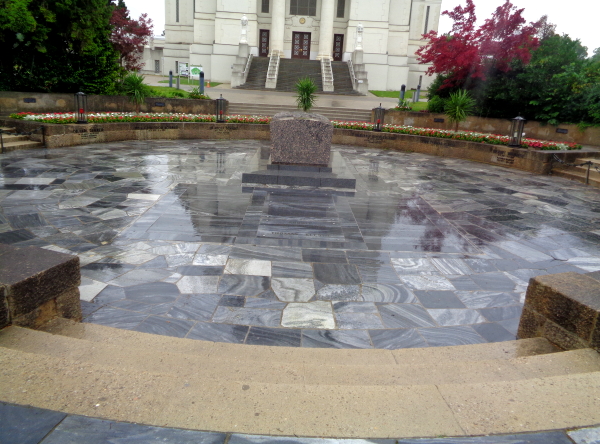
Another point of interest at the Vienna Central Cemetery is the Federal Presidents’ Crypt, located directly in front of the large cemetery church. This section is dedicated to Austria’s modern political history.
Here lie the graves of the six Austrian Federal Presidents who died after World War II. The crypt was created to honor their role in rebuilding and shaping the Republic of Austria after 1945. Because of its central location near the church, the site is easy to find and is often visited alongside the nearby composers’ graves.
The Federal Presidents’ Crypt offers a quieter, more reflective contrast to the famous musicians’ graves and provides insight into Austria’s political past as well as its cultural heritage.
Wild Animals at Vienna Central Cemetery
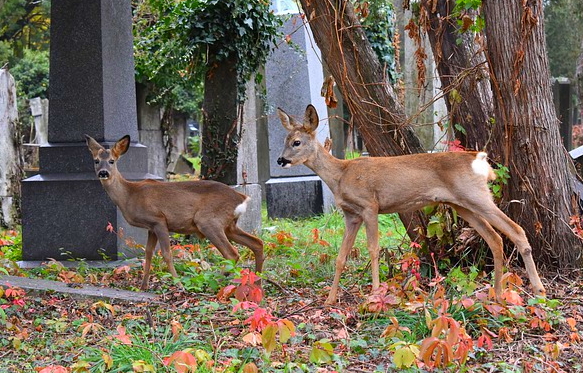
Because of its enormous size and many green areas, the Vienna Central Cemetery is also an unexpected refuge for wildlife. Large meadows, old trees and flower beds create a natural environment that supports a wide range of animals.
In spring and summer, the many flowers attract bees and colorful butterflies, while squirrels can be seen almost everywhere in the cemetery, especially along the quieter paths. Birds are also common, making the area feel more like a large park than a traditional cemetery.
Particularly interesting are the deer that live in the less visited sections of the cemetery. They tend to stay away from the main paths and busy areas, but patient visitors sometimes spot them in the early morning or late afternoon. Some people even visit the Central Cemetery mainly to observe the wildlife, enjoying the peaceful atmosphere far away from the city traffic.
Song About the Vienna Central Cemetery
The Vienna Central Cemetery is not only well known as a historic burial ground, but also as part of Austrian popular culture. One of the most famous songs about the cemetery was written and performed by Wolfgang Ambros, one of Austria’s most influential musicians.
The song, sung in Austrian dialect, became one of Ambros’ biggest hits and is especially popular in Austria. With a mix of dark humor and local identity, it reflects the special relationship Viennese people have with their Central Cemetery. For many Austrians, the song is instantly recognizable and closely associated with Vienna itself.
For international visitors, the meaning of the lyrics is not always obvious at first. However, a YouTube video with subtitles makes it easy to understand the song’s message and its cultural background. Watching it is a nice way to get a deeper impression of how strongly the Vienna Central Cemetery is embedded in everyday Austrian culture.