 Posted by
The Hundertwasserhaus Vienna is one of the city’s most photographed landmarks
and a unique example of unconventional architecture.
Designed by the Austrian artist Friedensreich Hundertwasser,
the building stands out with its colorful façade, irregular shapes,
and strong connection to nature.
KunstHausWien – Museum Hundertwasser
The Hundertwasserhaus is a private residence and has no public admission. This Tiqets ticket is for KunstHausWien, a separate museum dedicated to Hundertwasser’s work.
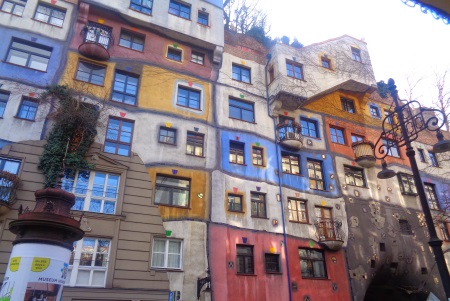
What Is the Hundertwasserhaus?
The Hundertwasserhaus is a residential building completed in 1985.
It was designed by artist Friedensreich Hundertwasser
in collaboration with architect Josef Krawina.
The building rejects straight lines and uniformity,
instead focusing on organic forms, bright colors, and greenery.
Despite its fame, the Hundertwasserhaus is a private residential building.
Visitors can view it from the outside, but the apartments themselves are not open to the public.
Who Was Friedensreich Hundertwasser?
Friedensreich Hundertwasser (1928–2000) was an Austrian artist and architect
known for his opposition to straight lines and industrial uniformity.
He believed that architecture should harmonize with nature
and give individuals creative freedom.
His ideas are also explored in nearby attractions such as
the Weltmuseum Vienna
and the Kunsthistorisches Museum,
which offer a broader cultural context.
What Makes the Hundertwasserhaus Special?
- Bright, irregularly colored façade
- Uneven floors and non-linear architecture
- Trees and plants growing from windows and balconies
- No two windows are exactly the same
Hundertwasser described this idea as the “right of the window”,
giving residents freedom to shape their living space.
Hundertwasser Village
Directly opposite the Hundertwasserhaus is the Hundertwasser Village.
This area includes a small shopping center, café, and exhibition space
designed in a similar artistic style.
It is the best place to learn more about Hundertwasser’s ideas
and to buy souvenirs inspired by his work.
How Much Time Should You Plan?
Viewing the Hundertwasserhaus itself takes about
15 to 30 minutes.
If you also visit the Hundertwasser Village,
plan around 45 to 60 minutes.
The site works well as a short stop during a day of sightseeing.
Location and How to Get There
The Hundertwasserhaus is located in Vienna’s 3rd district (Landstraße).
It is easy to reach by public transport.
- Tram: Line 1 (stop: Hetzgasse)
- Metro: U3 to Rochusgasse, then a short walk
For detailed route planning, see the
Vienna local transport guide.
Combine the Hundertwasserhaus with Other Attractions
Because of its location, the Hundertwasserhaus is easy to combine
with nearby sights.
Popular combinations include:
- Prater Vienna
- Hard Rock Cafe Vienna
- A walk along the Danube Canal
Conclusion
The Hundertwasserhaus Vienna is a striking contrast
to the city’s imperial architecture.
With its colorful design, organic shapes, and environmental ideas,
it offers a short but memorable sightseeing stop.
For visitors interested in modern art and architecture,
it is one of Vienna’s most distinctive attractions.
Vienna Travel Guides – Useful Before Your Visit
How to visit Hundertwasserhaus Vienna
The Hundertwasserhaus is a residential building, so the visit is an architectural stop viewed from public streets rather than an indoor attraction. The colourful façade, uneven lines, planted balconies and varied windows are best appreciated from several angles around the corner of Kegelgasse and Löwengasse. The building is lived in, and residents have a right to privacy. Keep the entrances clear, speak quietly, do not ring doorbells and do not try to enter the apartments or follow residents inside.
For most visitors, 15 to 30 minutes is enough to see the exterior and take photographs. The visit is free because you are looking at the façade from public space. There is no standard entrance ticket for the residential building and no public tour through the apartments. This distinction is important when planning: a ticket advertised for a Hundertwasser museum refers to a different attraction, usually KunstHausWien, and does not provide access to the house.
Best place to view and photograph the façade
Start at the junction of Kegelgasse and Löwengasse and walk slowly along the pavement to see the façade from more than one position. The building’s irregular windows and coloured surfaces look different as the angle changes. In bright daylight the colours are vivid, while overcast conditions can make the forms and textures easier to photograph without harsh shadows. The pavement is relatively narrow in places, so move aside for residents and other pedestrians instead of standing in the middle of the street.
Early morning is often calmer than the middle of the day, particularly in high season when tour groups stop for photographs. The house is visible throughout the day, but it is not floodlit as a scheduled show. Be considerate when visiting early or later in the evening because people live behind the windows. Avoid using a drone or blocking traffic for a photograph.
Hundertwasser Village opposite the house
Across the street is the Hundertwasser Village, a visitor area designed in the artist’s style. It has shops and places to eat, and it is open to the public during its operating hours. The Village offers a chance to see a Hundertwasser-inspired interior without entering the private apartment building. Its scale is small, so most people spend a short time browsing rather than treating it as a full museum visit. Check current shop and café hours if you are planning around a meal or a specific purchase.
The Village and the Hundertwasserhaus are separate from KunstHausWien. The first is a visitor-oriented arcade near the residential landmark; the second is a museum several minutes away on foot. Do not confuse either one with public access to the apartments. For a more substantial introduction to Hundertwasser’s art, the museum is the better choice.
KunstHausWien: the museum for Hundertwasser’s work
KunstHausWien – Museum Hundertwasser is the most useful nearby indoor visit for anyone interested in the artist. The museum presents works by Hundertwasser and changing exhibitions, and its own building is also part of the experience. It is not the same property as the Hundertwasserhaus, and tickets for the museum do not include entry to the residential house. The museum’s official site currently lists daily opening from 10:00 to 18:00 and a last admission 30 minutes before closing; verify the schedule for your date.
From January 2027, the museum’s official visitor page lists a standard admission price of €18, with reduced rates and family options. Prices and exhibitions may change, so consult the official page before visiting. The museum is also a more weather-proof option than a quick street stop. If you want to see both, visit the house first and then walk to KunstHausWien, or reverse the order depending on opening hours and your route.
Getting there by public transport
The Hundertwasserhaus is in Vienna’s 3rd district, Landstraße. Tram 1 serves the nearby area; other routes and stations may be convenient depending on where you start. The city centre is walkable for visitors who enjoy a longer urban route, but the trip is not right beside Stephansplatz. Check live public transport information before setting off, especially if works or diversions affect the route. Our Vienna public transport guide explains tickets, metro, trams and buses.
There is no need to arrive at a timed entry slot for the exterior. If you are adding KunstHausWien, confirm its ticket conditions separately. Visitors arriving by taxi should ask to be dropped at a suitable public street location and avoid blocking the residential entrance.
Accessibility and practical comfort
The exterior can be viewed from the public pavement, but street surfaces, kerbs and crowding may affect comfort for wheelchair users or people with limited mobility. The area is a real residential neighbourhood rather than a controlled visitor platform. Choose a quieter time, allow enough space to turn or pause, and check the route conditions if step-free travel is essential. KunstHausWien has its own accessibility arrangements, which should be reviewed directly with the museum before buying a ticket.
There are cafés and visitor facilities in the surrounding area, but services at the Hundertwasser Village can vary. Do not expect benches, visitor toilets or staff assistance at the exterior itself. Bring a water bottle in warm weather and combine the stop with another nearby attraction rather than travelling across town for only a brief photograph.
Accommodation in Vienna
Compare central locations, public transport access and booking conditions for your Vienna stay.
Is Hundertwasserhaus worth visiting?
It is worthwhile as a short, free architecture stop, particularly if you are already exploring the 3rd district or plan to visit KunstHausWien. The building offers a clear example of Hundertwasser’s rejection of uniform façades and strict straight lines. However, visitors expecting a large attraction or access inside may be disappointed. Knowing in advance that the house is viewed from outside makes the visit easier to fit into a realistic itinerary.
If you have limited time in Vienna, compare the short exterior visit with the city’s major museums and palace sights. Hundertwasserhaus works well as part of a neighbourhood walk, while the Hofburg, Schönbrunn Palace and Kunsthistorisches Museum require more time. The Weltmuseum Wien is another nearby-in-the-centre option for travellers interested in museum collections.
Suggested half-day itinerary
Begin with the Hundertwasserhaus exterior, then browse the Village opposite if it is open. Walk to KunstHausWien for the museum and allow time for the galleries and café. If you prefer outdoor space, continue towards the Danube Canal or take public transport back to the Innere Stadt. This plan leaves room to stop for lunch and avoids trying to see several major museums in one morning.
For a longer Vienna itinerary, use our guides to walking around Vienna and getting to the city. A hotel near the centre or a well-connected U-Bahn station makes it easier to combine attractions in different districts. Compare location, cancellation terms and transport access before booking accommodation.
Frequently asked questions
Can visitors go inside Hundertwasserhaus?
No. It is a private residential building and can only be viewed from outside. Please respect the residents and do not enter apartment areas.
Does the Hundertwasserhaus cost anything to see?
The exterior can be viewed free of charge from public streets. KunstHausWien is a separate museum with its own admission ticket.
How long should I allow?
Allow about 15 to 30 minutes for the building and the Village. Add around two hours or more for a separate museum visit, depending on the exhibitions and your interests.
Is there a specific Hundertwasser ticket on Tiqets?
The residential house has no admission ticket. The Tiqets link on this page is for KunstHausWien – Museum Hundertwasser, a distinct museum, and should not be understood as access to the apartments.
Official and related information
- Vienna Tourist Board: Hundertwasser House
- KunstHausWien official visitor information and 2027 prices
- Getting around Vienna
- Vienna city walk
Architecture details to notice
Look beyond the overall colour scheme when viewing the Hundertwasserhaus. The façade combines different surface textures, uneven edges and windows that do not follow one repeated grid. Trees and shrubs grow from terraces and roofs, creating a relationship between housing and vegetation that was central to Hundertwasser’s architectural ideas. The design challenges the uniform street front typical of many apartment blocks, but it is still a functioning residential building rather than a purpose-built monument.
The artist’s ideas were developed with professional architects and engineers. Josef Krawina was involved in the project, and later work was carried out with architect Peter Pelikan. The building was constructed as municipal housing and completed in the mid-1980s. This background helps visitors understand why it is important to treat the building as someone’s home, not merely a photo backdrop.
What to expect at the Village
The Hundertwasser Village offers a compact stop with shops and food options in an interior decorated to echo the artist’s approach. It is useful for a short look at colourful floors, irregular surfaces and design details. It is commercial in character, so visitors should approach it as a small arcade rather than as a major museum. Opening hours and individual shop availability can change; check in person if you have a particular place in mind.
There is no need to reserve a time for viewing the exterior. If you want to visit KunstHausWien, allow time to see its collection and check whether the current exhibitions match your interests. Use the official museum site for opening times, 2027 prices and ticket rules, because those details may change. Keep the two attractions distinct in your itinerary and in your expectations.
Accessibility and crowds
The exterior is viewed from sidewalks in a residential neighbourhood. The street can become crowded around popular photo positions, especially when tour groups arrive. Visitors using wheelchairs or mobility aids should consider pavement width, kerbs and surface conditions; an accessible viewpoint may be limited by street layout. A quiet time of day makes it easier to move and pause without blocking others.
For a low-stress visit, keep the route short, look from more than one side and move on when the pavement is busy. The city’s central transport network makes it possible to combine the stop with other districts without walking the full distance. If weather is poor, spend more time at KunstHausWien, which is indoors, and treat the façade as a brief outdoor stop.