 Posted by
 Many visitors to Vienna choose to take a day trip to Bratislava. The two European capitals are only about 60 kilometres apart. While travelling by car is possible, public transport is generally the better option.
Trains run twice per hour between Vienna and Bratislava and take around one hour, making this a fast and convenient connection. Another very popular and scenic alternative is travelling by boat from Vienna to Bratislava along the Danub
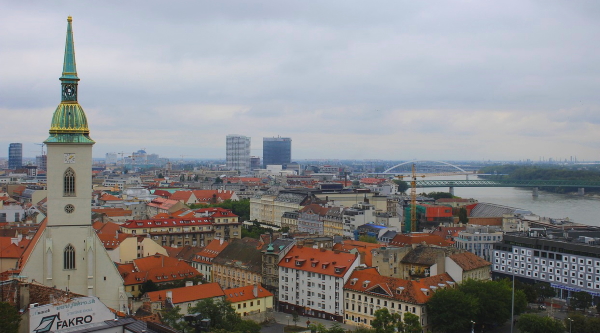
Travel from Vienna to Bratislava
By boat:
Fast catamarans operate almost daily between Vienna and Bratislava. Departures in Vienna are from Schwedenplatz, which is well connected by underground. In Bratislava, the boats arrive very close to the city centre. The journey takes around two to three hours one way, making this option more suitable for a long day trip.
By boat and bus (recommended):
A popular option is a day trip to Bratislava by bus and return by boat. Travelling one way on the Danube is usually sufficient, as the boat journey is quite long. More info and booking on this link
By train:
Trains run twice per hour between Vienna and Bratislava. This is the fastest and usually cheapest way to travel, although less scenic than the boat. Travel time is about one hour. Each hour, one train goes to Bratislava Main Station and another to Bratislava-Petržalka. From the main station, the old town can be reached on foot in around 20 minutes. From Petržalka station, located on the other side of the Danube, buses run every few minutes, with a stop directly in front of the station.
Bratislava Ticket:
A very affordable option by train is the Bratislava Ticket. It costs around 16 euros per person for a return trip from Vienna and includes local public transport in Bratislava, making it ideal for a day trip from Vienna Main Station.
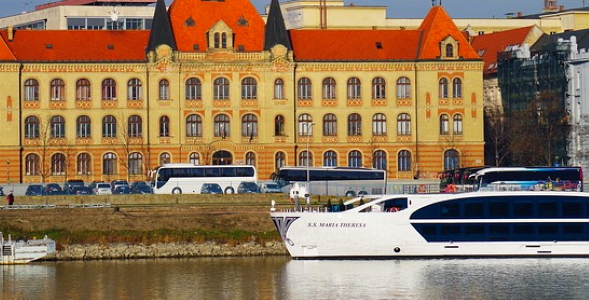
By bus:
There are also several private bus operators offering connections between Vienna and Bratislava. Particularly good value for money are services provided by FlixBus, which are often the cheapest option.
Sights of Bratislava
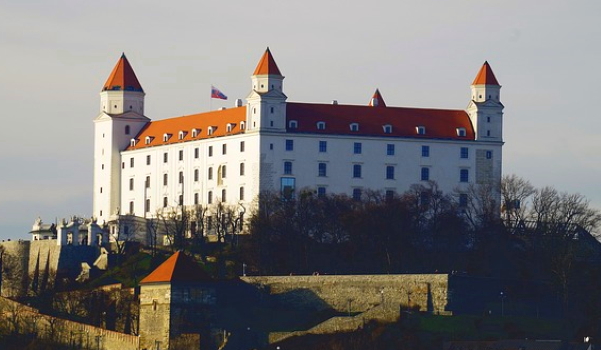
The Bratislava Castle is without doubt the most important and most visible landmark of the Slovak capital. It stands on a prominent hill above the Danube, directly next to the historic old town, and can be seen from many parts of the city. Because of its elevated position, the castle has always played a key strategic role in the region.
The walk up to the castle from the old town involves a steady climb and can be quite tiring, especially on hot summer days. Nevertheless, the effort is well worth it. From the castle grounds, visitors are rewarded with panoramic views over Bratislava, the Danube, and on clear days even parts of Austria and Hungary.
Today, the castle complex is well maintained and open to visitors. Inside, there are exhibitions and museum sections that focus on Slovak history, art and archaeology. Even if you do not plan to visit the interior, a walk around the castle courtyards and along the walls is highly recommended. The open spaces, views and photo opportunities make the Bratislava Castle a highlight of any visit to the city.
Good guided tour of Bratislava: We recommend this short, good guided tour daily at 12 noon, duration 1 hour. >>> More info and booking on this link.
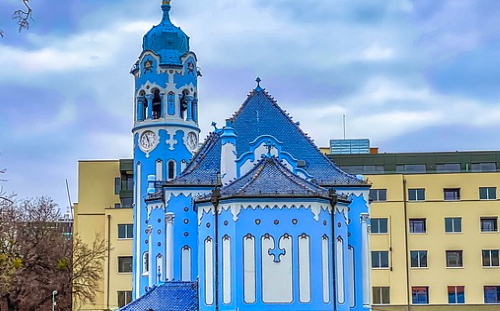
The Blue Church, located not far from Bratislava’s Old Town, is one of the city’s most distinctive and photogenic sights. Its official name is the Church of St. Elizabeth, but it is widely known as the Blue Church because of its unusual colour scheme.
Almost everything about the building is blue. The façade, the roof, the tower and many decorative details are painted in soft shades of light blue, complemented by white elements. This colour combination makes the church stand out clearly from its surroundings and gives it a fairytale-like appearance.
Architecturally, the Blue Church is a fine example of Art Nouveau. The playful shapes, curved lines and ornamental details make it very different from the more traditional churches found elsewhere in Bratislava. Because of its compact size and unique design, the church is especially popular with photographers and visitors looking for something a little different.
Thanks to its location close to the Old Town, the Blue Church can easily be combined with a city walk. Even a short stop is worthwhile, as the exterior alone is impressive and memorable. For many visitors, the Blue Church is one of the most charming and surprising sights in Bratislava.
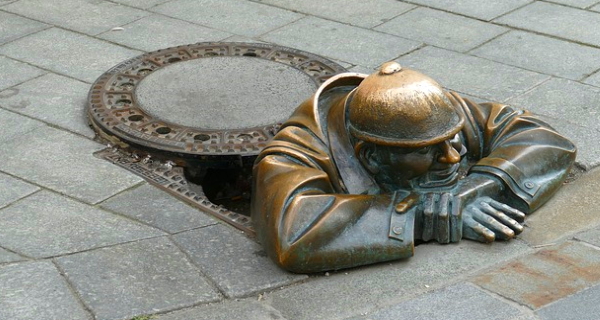
A relatively modern attraction in Bratislava is a small monument located in the middle of the pedestrian zone. It depicts a man peeking out of a manhole and is known as Čumil (often translated as “Man at Work”).
The sculpture has become one of the city’s most photographed sights. Many visitors stop here for a short break, and it is common to see tourists taking pictures or posing next to the figure. Despite its simple design, the statue adds a touch of humour to the old town and has become a well-known symbol of Bratislava.
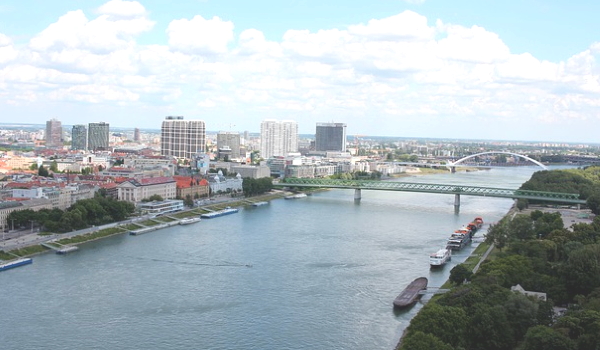
A walk along the banks of the Danube is also highly recommended when visiting Bratislava. The historic old town lies directly on the river, which is particularly wide and impressive at this point. From the promenade, you get beautiful views of the water, the surrounding cityscape and the nearby hills.
If you cross the long bridge over the Danube, you reach the opposite riverbank within a few minutes. Here you will find Aupark, a very large and modern shopping centre with numerous shops, cafés and restaurants. It is a convenient place for a short break, especially after sightseeing in the old town.
The Danube riverbank is ideal for a relaxed walk and offers a pleasant contrast to the narrow streets of the old town. Especially in good weather, this area is one of the nicest places to spend some time in Bratislava.
Our impression: Is a trip to Bratislava worth it?
Travelling from Vienna to Bratislava can be done in different ways. If you choose the boat along the Danube, it makes for a long day due to the travel time. However, the boat trip itself is a special experience and very scenic. By train, the journey is much faster and usually cheaper, making it the more practical option for a day trip.
The old town of Bratislava, historically known by its German name Pressburg, is attractive and largely pedestrianised. It is pleasant to stroll through, with many cafés and restaurants that are noticeably cheaper than those in Vienna. At the same time, Bratislava does not offer as many major highlights as nearby capitals (Vienna, Prague, Budapest).
Guided city tour in Bratislava:
We recommend a short and well-organised guided walking tour in German, which takes place daily at 12:00 noon and lasts about one hour. More info and booking on this link.
In our opinion, Bratislava can be explored comfortably within a few hours, which makes it ideal for a day trip from Vienna. For a longer stay of several days or even a full week, however, the city itself offers relatively limited attractions for tourists. Outside the old town, Bratislava still shows strong traces of its socialist past, with wide multi-lane roads, heavy car traffic, few cycle paths and many prefabricated apartment blocks from the communist era.
If you have more time:
The surrounding region is well worth exploring. Areas such as the Little Carpathians offer excellent opportunities for hiking and nature walks, with forests and green landscapes close to the city.